Doing an At-Home Liver Test Without Insurance: Advantages, Costs & the Process
By Alan Farrell3 min read

A direct path to liver testing
At-home testing gives you a clear upfront price without waiting for a referral, insurance approval or a separate lab appointment.
One upfront cost Know what the test costs before you order instead of waiting for insurance processing or a lab bill.
No clinic visit Collect a finger-prick sample at home and return it using the prepaid mailing materials.
Trackable results Use your dashboard to understand your markers and compare future results with your baseline.
What You’ll Learn:
1 How to do a liver test without going through insurance
2 Why at-home liver testing may be more cost effective than using insurance
3 How much an at-home liver test costs without insurance coverage
4 The advantages of an at-home liver test versus a doctor’s office
Liver testing without insurance coverage is possible, and it might end up being less expensive than getting tested the traditional way with a doctor. Plus, an at-home liver test also tends to be a lot easier, and you can get the results much quicker.
Never tested your liver function before? Start with the Liver Function Test to measure the core liver markers and establish a baseline you can compare over time.
Test without waiting on insurance
Choose the focused 7-marker liver test or the broader Comprehensive Liver Function Test.
Get the Liver Function Test Get the Comprehensive test
LIVER15 automatically applied · $15 off standard · LIVER30 automatically applied · $30 off comprehensive

What the Process is Like With an At-Home Liver Test
Simplification is one of the reasons why people prefer at-home liver tests. It’s much simpler than getting a liver function test ordered through a physician.
Choose Health
The at-home process
- Order a liver function test on the website.
- It arrives in 3-5 days with instructions.
- Do a finger-prick test to collect a blood sample.
- Put the sample in the prepaid mailer and drop it off with USPS.
- The sample is sent to a certified lab that analyzes it.
- The results are uploaded into your online dashboard within days of the lab receiving the sample.
- Review the data, interpretations and personalized recommendations.
- Save the information so you can discuss it with your doctor at your next appointment.
Traditional route
Testing through a doctor
- Schedule a doctor’s visit and wait for the appointment.
- Go to the doctor’s visit for an evaluation.
- If appropriate, the doctor orders the blood test.
- Your insurance company may need to review the order.
- Schedule another appointment at a lab.
- The lab performs a full blood draw.
- The lab sends the results to your doctor.
- Wait for the office to communicate the results and next steps.
You can schedule an optional video chat with a medical professional if you have questions or want more clinical guidance. The at-home route can mean fewer appointments, clearer access to your results and a dashboard designed for tracking changes over time.
Why At-Home Liver Testing is Sometimes More Cost Effective Than Using Insurance
There’s a misconception that when health insurance covers something it’s free. Sometimes that’s true, but usually the patient is still paying something out-of-pocket. There are also indirect costs that increase the overall expense that’s associated with testing through a doctor.
With an at-home liver test there’s a single cost. You pay for the test and that’s it. Testing through your physician can involve a number of separate expenses.
Doctor copay An office visit may be required before testing.
Lab fees Diagnostic lab work may be subject to your plan.
Parking Clinic and lab visits can add incidental costs.
Transportation Gas, transit or rides add to the total expense.
Time off work Appointments can carry an indirect cost.
Liver testing may be classified as diagnostic depending on why it is ordered and your insurance plan. Diagnostic lab work can be subject to copays, deductibles or coinsurance. If an insurer does not consider the test medically necessary, you may be responsible for the full cost.
How Much At-Home Liver Tests Cost Without Insurance Coverage
As noted, the cost of at-home liver testing is much more straightforward. However, there is a range in the cost since no two at-home liver tests are exactly alike.
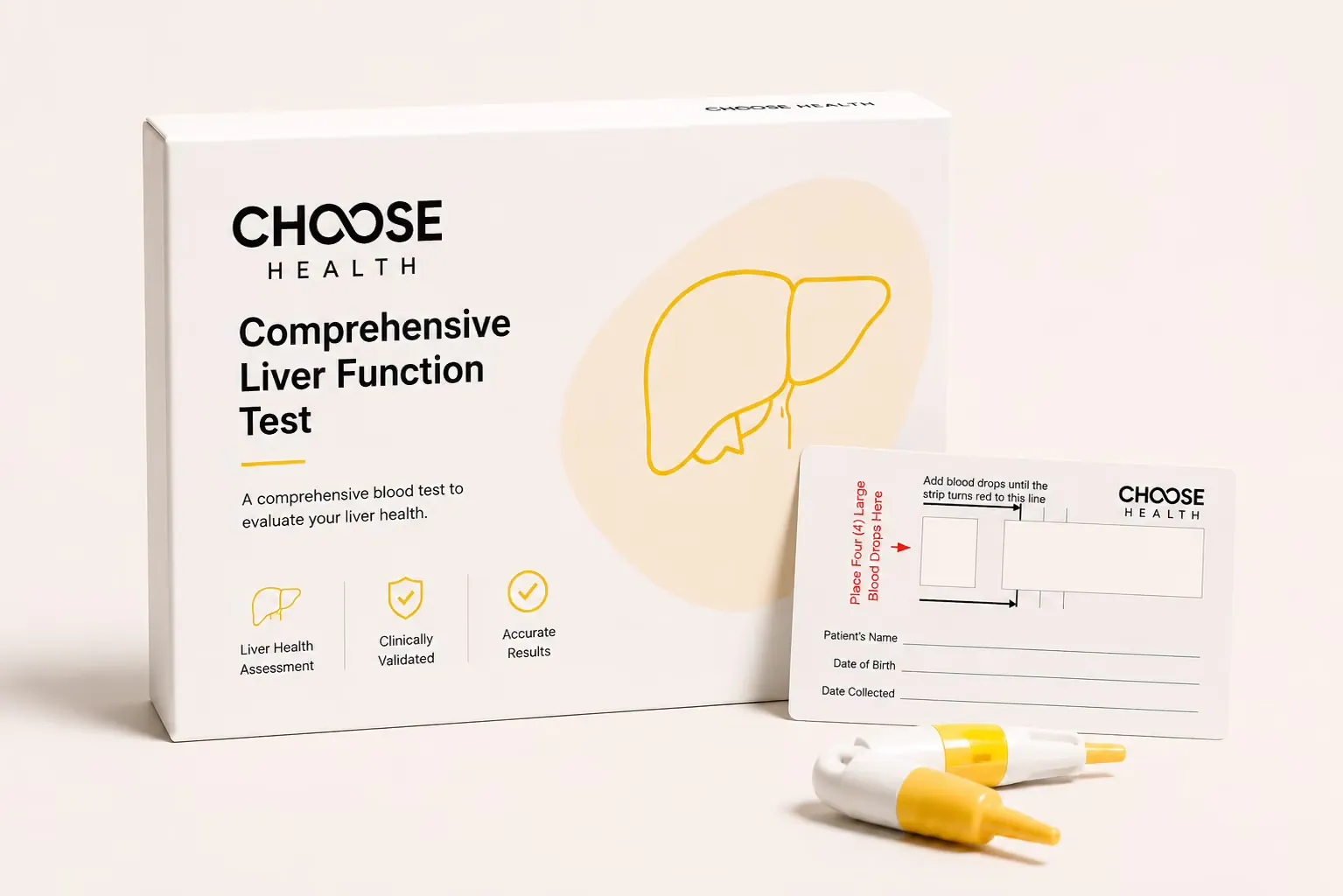
With a truly at-home liver test like the ones from Choose Health, you can do a Liver Function Test for $75 using discount code LIVER15. The test includes 7 key markers that are used to gauge liver and metabolic health. There’s also a Comprehensive Liver Function Test that includes 20+ markers and metrics for an expanded assessment that includes cardiovascular and metabolic health.
You can go into a lab and do a blood draw to test liver markers for around $80, but it’s not really an at-home blood test. It’s much closer to getting a test through a doctor, just without the doctor’s referral visit. You may receive the raw lab results without the same interpretation or trackable dashboard experience.
There are also at-home test providers that offer annual memberships and subscriptions for one large panel. This option can be more expensive because dozens of markers are tested at once. For example, liver enzymes may be bundled into a larger annual program rather than offered as a focused one-time test.
Our comparison of at-home liver tests has a thorough breakdown of different costs, included biomarkers and sample-collection methods.
Focused liver testing
Liver Function Test
$75 with LIVER15
Measure ALT, AST, GGT, AST:ALT ratio, HbA1c, hsCRP and visceral fat with one finger-prick sample.
LIVER15 automatically applied · $15 off
Liver and metabolic testing
Comprehensive Liver Function Test
$135 with LIVER30
Measure liver enzymes alongside bilirubin, glucose, insulin, HbA1c, cholesterol, iron markers and more.
LIVER30 automatically applied · $30 off
Know the price before you test
Order directly, collect your sample at home and review your results in one secure dashboard.
Test 7 core markers Test the broader picture
LIVER15 automatically applied · $15 off standard · LIVER30 automatically applied · $30 off comprehensive
Additional Advantages of an At-Home Liver Test vs a Doctor’s Office Blood Draw
The convenience, saved time and potentially lower cost are all benefits of at-home liver tests that don’t involve insurance. Here are a few more benefits that make liver testing at home even more advantageous:
HSA/FSA eligible Many at-home testing providers accept eligible HSA and FSA payments.
Track changes over time Compare future results with your baseline to notice trends in key biomarkers.
Clear interpretation See what each measurement means and why the marker is relevant.
Clinical guidance available Access medical professionals who can answer questions and review results.
Accredited lab processing Choose Health samples are analyzed by CAP and CLIA-accredited laboratories.
Results in one dashboard Keep your information accessible for future comparison or a conversation with your doctor.
Test directly and keep the data
If you want to test your liver enzymes but you’re nowhere near hitting your annual maximum out-of-pocket for insurance, or there’s a good chance your insurance won’t pay for a diagnostic or monitoring test, Choose Health offers a straightforward at-home option.
Your test results are accessible through an online account that makes it easier to know what the metrics mean, how they change over time and what you can do to improve your liver function. For more detail on the markers and collection process, read the guide to testing and tracking liver enzymes.
Order an at-home liver test
Choose the focused test for your core liver markers or the Comprehensive test for a broader liver, metabolic, cardiovascular and iron-health picture.
Get the Liver Function Test Get the Comprehensive test
LIVER15 automatically applied · $15 off standard · LIVER30 automatically applied · $30 off comprehensive
Choose Health tests provide health information and are not a substitute for medical advice, diagnosis or treatment. Insurance coverage, billing and out-of-pocket costs vary by plan and reason for testing.