How Often Should You Get Blood Work on a GLP-1?
By Choose Health6 min read

Know your liver and hormone levels
It's difficult to know how well your liver is working, or whether hormones are elevated, until something has gone far enough to produce symptoms. Both are measurable well before that point.
If you drink regularly, a liver function test gauges your risk of fatty liver disease and alcohol-related liver stress. A hormone panel tells you where estradiol and testosterone actually sit.
Start here · 20+ biomarkers · DBS finger-prick
Comprehensive Liver Function Test
The liver side of the picture: enzymes, metabolic markers and the calculated scores that estimate fatty liver risk.
- Liver : Albumin, AST, ALT, GGT, total bilirubin
- Metabolic : Fasting glucose, fasting insulin, HbA1c
- Calculated scores : Fatty Liver Index, Hepatic Steatosis Index, AST:ALT ratio
$135$165 LIVER30 saves $30
At-home finger-prick collection. Results in days.
For estradiol and testosterone specifically:
Women's Longevity Panel Estradiol, progesterone, testosterone, SHBG and thyroid markers $195 ↗ Men's Longevity Panel Testosterone, free testosterone, estradiol, SHBG and PSA $195 ↗
This article is for informational purposes and is not a substitute for medical advice, diagnosis or treatment. If you drink heavily, do not stop abruptly without medical guidance, as alcohol withdrawal can be dangerous. Talk to a healthcare provider about your results, your drinking and any treatment options.
The recommended testing schedule
Checkpoint 1 / Before you start
Baseline testing
Before your first injection, your provider should have a clear picture of where your body is starting from. A baseline panel typically covers:
| Panel | What it covers |
|---|---|
| Comprehensive metabolic panel | Glucose, kidney markers (BUN, creatinine, eGFR), liver enzymes (ALT, AST, ALP, bilirubin) and electrolytes |
| HbA1c | Average blood sugar over roughly the past 3 months |
| Lipid panel | Total cholesterol, LDL, HDL and triglycerides |
| Thyroid panel | TSH, sometimes free T4, given the thyroid-related labeling on these medications |
| Complete blood count | Screens for anemia and other blood-related issues |
| Vitamin B12 and D | A reference point before appetite changes take hold |
Why the baseline is the one you can't skip. If something shifts three months into treatment, a baseline is what lets your provider tell whether the medication caused it, or whether it was already there and simply hadn't been caught.
Checkpoint 2 / 6 to 8 weeks
The first retest
This window typically lines up with your first dose increase, which is when your body is adjusting most and when side effects, or early wins, tend to show up first. The retest usually focuses on three things.
| Focus | Why now |
|---|---|
| Kidney and electrolytes | Catches dehydration-related strain from GI side effects before it becomes a bigger problem |
| Early blood sugar trends | Glucose and sometimes A1c, to see whether things are moving in the right direction |
| Lipid panel | Often early for a dramatic shift, but useful as a second data point |
This is also the checkpoint that most directly informs dosing. If your labs and symptoms both look good, your provider may move you up. If something's off, this is the moment to catch it.
Checkpoint 3 / Every 3 to 6 months
Ongoing monitoring
Once you're stable on your dose, testing shifts from watching closely to keeping tabs. Which interval applies depends on your situation.
Every 3 months
If you're still managing a chronic condition like diabetes or kidney disease, or if anything was abnormal on a previous panel.
Every 6 months
Once you're on a stable dose, tolerating the medication well, and your labs have been consistently normal.
At this stage panels typically recheck A1c and lipids to confirm the metabolic benefits are holding, kidney and liver function as routine safety checks, and thyroid function and vitamin levels, since reduced intake tends to be a long-term reality on these medications rather than a first-month adjustment.

Quick answers on GLP-1 testing timeframes
How often should you get bloodwork on Ozempic®?
Baseline before starting, a follow-up at 6 to 8 weeks, then every 3 to 6 months for as long as you're taking it. Testing may be needed more often if you have kidney disease, liver disease, or results outside the normal range.
When should you retest on Wegovy®?
Same cadence as Ozempic®, since both are semaglutide. Whether the medication is prescribed for diabetes or weight management doesn't change the monitoring schedule.
Does the schedule change if I switch GLP-1 medications?
Not fundamentally. Whether you're on semaglutide (Ozempic®, Wegovy®) or tirzepatide (Mounjaro®, Zepbound®), the same systems are monitored for the same reasons. Your provider may adjust the exact interval based on how the switch affects you.
How much do GLP-1 blood tests cost?
Prices vary widely, partly on collection method and partly on how many biomarkers are measured. At-home panels generally run $125 to $185, in-person walk-in labs $165 to $175 with a physician fee, and bundled telehealth programs $900 or more.
Which test for which checkpoint
The two panels are built for different moments. Comprehensive gives you the fuller picture you want at baseline. Basic covers the core safety and metabolic markers at a price that makes repeat testing sustainable.
Best for baseline
Comprehensive GLP-1 Test
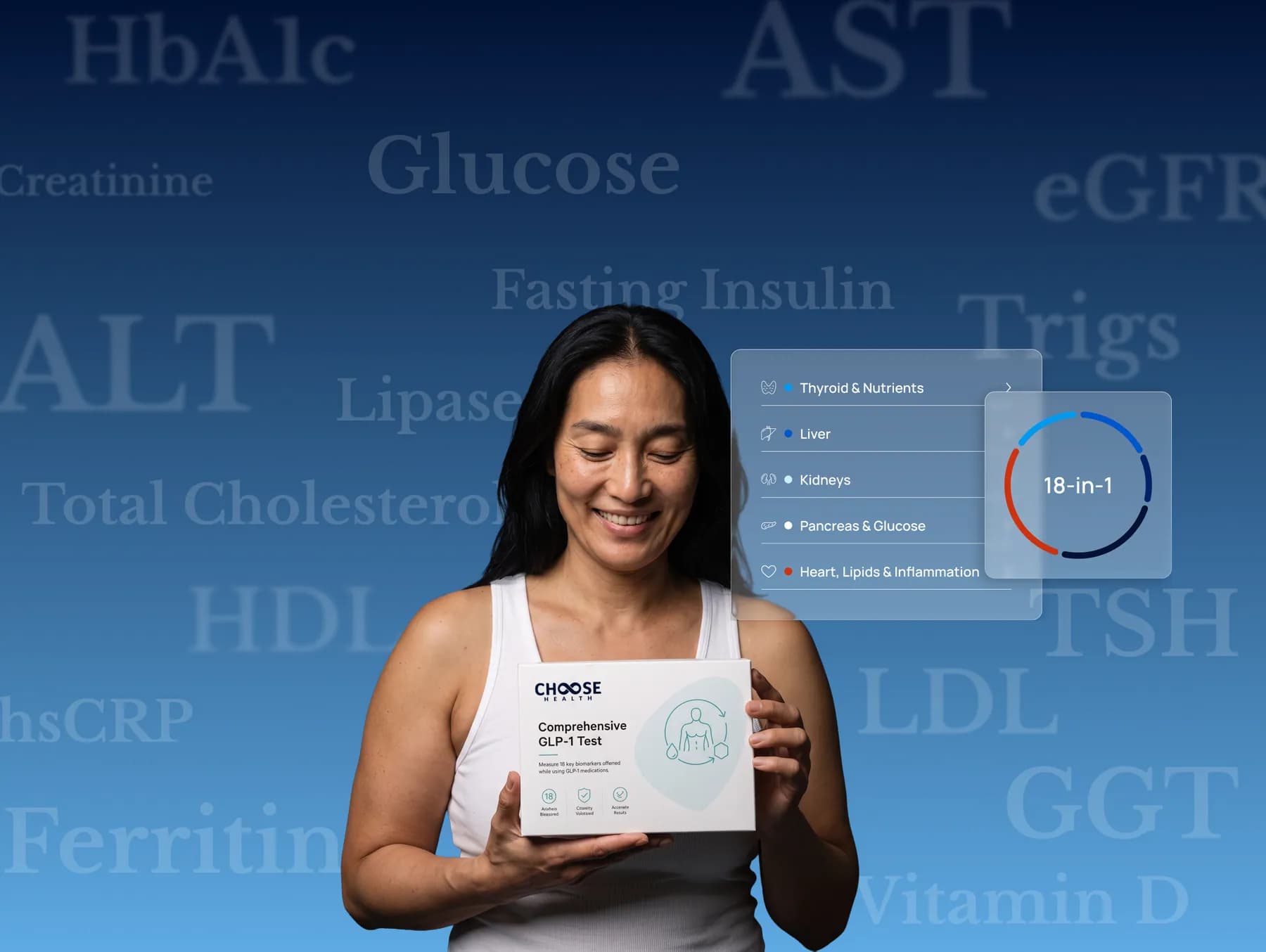
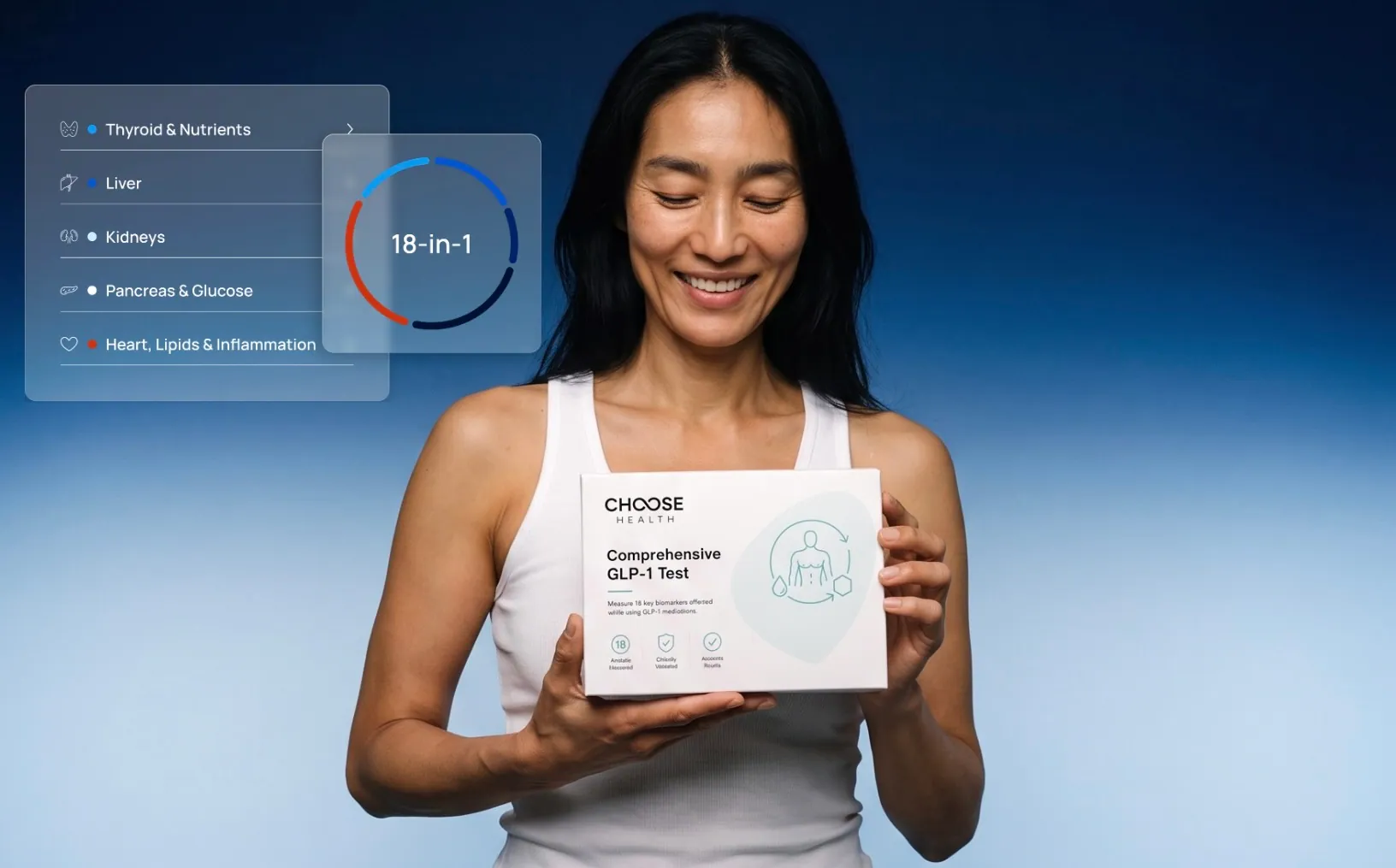
18 markers across blood sugar, liver, kidney, pancreatic, lipid, thyroid and inflammation. The fuller reference point before your first dose.
$185
GLP35 for $35 off
Best for retests
Basic GLP-1 Test
9 core markers covering blood sugar, liver, kidney and pancreatic function. An affordable way to monitor as treatment progresses.
$125
GLP15 for $15 off
This article is for informational purposes and is not a substitute for medical advice, diagnosis or treatment. Do not start, stop or change a prescribed medication based on at-home test results. Follow the monitoring schedule your prescribing clinician sets for you. Ozempic, Wegovy, Mounjaro and Zepbound are registered trademarks of their respective owners and are not affiliated with Choose Health.