Taking Unregulated Peptides? Here's What to Know About Your Kidney & Liver Health
By Alan Farrell6 min read

On This Page:
- Details on the FDA’s approval of peptides
- What are peptides exactly
- Which peptides are recommended for approval
- Why people are still taking unregulated peptides
- How peptides impact liver function
- How peptides impact kidney function
- What biomarkers are recommended for monitoring while on peptides
Peptides have been a hot topic in the health world for several years, and right now they are at the center of an FDA approval debate. The FDA scientific staff didn’t recommend approval due to lack of human efficacy evidence and understanding of long-term safety.
But an FDA advisory committee narrowly voted to recommend placing six peptides on the 503A Bulks List. That means peptides haven’t been approved - yet.
It’s still far from a final ruling by the FDA, but the recommendation has had an impact on how people view peptides and their safety. Since it will be some time before peptides are legally available, there’s good reason to believe more people could start purchasing peptides on the grey market.
Regardless of whether peptides come from a pharmacy or the grey market, anyone who is taking them should be monitoring their kidney and liver health. Here’s why.
Establish your baseline
Check liver, kidney and metabolic markers in one test
The Comprehensive Metabolic Test brings key markers connected to liver, kidney, metabolic and inflammatory health together in one at-home test.
Explore the Comprehensive Metabolic Test

What Are Peptides?
A peptide is sort of like a messenger. They are chains of amino acids that send signals to organs and cells to perform a function. The most well-known peptide right now is GLP-1 that are known to help regulate insulin and blood sugar levels.
Peptides are made naturally in the body, but they can also be made in a lab. There are thousands of peptides that serve a wide variety of purposes. Today they are being used to treat obesity, type 2 diabetes, for skincare, anti-aging and to aid in muscle recovery.
Which Peptides Gained a Recommendation
Before delving into the potential kidney and liver effects, take a look at which peptides were and weren’t recommended for FDA approval:
- BPC-157 - ulcerative colitis - recommended
- KPV - reviewed for wound healing and inflammatory conditions - recommended
- TB-500 - reviewed for wound healing - recommended
- MOTS-c - reviewed for obesity and osteoporosis - recommended
- Epitalon - reviewed for insomnia - recommended
- Semax - reviewed for cerebral ischemia, migraine and trigeminal neuralgia - recommended
- Emideltide / DSIP - reviewed for opioid withdrawal, chronic insomnia and narcolepsy - not recommended
The FDA advisory committee recommended the peptides in part because people are already using them. The argument is that it’s better to have them regulated and compounded in a pharmacy. It also doesn’t hurt that the peptide industry’s worth is projected to be almost $564 billion by 2035 with a compound annual growth rate (CAGR) of 7% to 11%.
And these peptides will likely be marketed for a lot more than what the committee voted on. They are already hyped up as being a solution for longevity, anti-aging and cognitive optimization, even though there’s little research to back up these claims.
Regardless of why people are interested in taking peptides, they still won’t be legalized and available for at least another 8-12 months.
What Peptide Bloodwork Protocols Reveal
We’re still learning about peptides, and the manufacturers know more than just about everyone else. Right now, it’s best to follow their recommendations on what to do before and during the use of peptides. The monitoring protocols are primarily focused on kidney and liver health along with blood pressure, lipids, metabolism and inflammation. Below are protocols from two manufacturers for monitoring kidney and liver function.
MediVera bloodwork protocols for kidney and liver function include:
- AST
- ALT
- Creatinine
- BUN
- Fasting Glucose
Sermorelin bloodwork protocols for liver function include:
- AST
- ALT
Based on these two manufacturers, there is a need to monitor how well the body’s clearance system is working.
Monitor more than one system
Check liver, kidney and metabolic markers from home
Use one at-home panel to establish a baseline and follow how key biomarkers move over time.
View the Comprehensive Metabolic Test
Peptides Impact on Liver Function: Good or Bad?
FDA scientists brought up a number of points about peptides. Clearance through the body was one of them.
The liver is the body’s filter. It gets rid of all the toxins, which is a pretty tough job. Some peptides help the liver recover, reduce inflammation and protect cells from damage, but the toxicity of others could be potentially harmful. And because some peptides help with lipid regulation there’s potential that they could help with fatty liver conditions.
Because you could see improvements or liver function decline while taking peptides, regular monitoring is highly beneficial.
How Peptides Affect Kidneys
Like the liver, the kidneys can be protected and improved by peptides or suffer damage. It largely depends on the peptide that’s taken.
Toxicity and filtration stress are the biggest concerns with the kidneys. The kidneys are what filters peptides out of the body. The process can lead to organ strain in some cases.
Then there are peptides like GLP-1 that reduce blood sugar, blood pressure and inflammation for a protective benefit.
There is also evidence that peptides could be protective and reduce cell death when there’s acute kidney injury.
Take a closer look at liver function
Compare a comprehensive liver panel with a streamlined option focused on essential liver markers.
Use LIVER30 for $30 off Comprehensive or LIVER15 for $15 off Basic.
Focus on kidney function
Explore an at-home panel measuring six key markers connected to kidney health.
The Real Concern With Unregulated Peptides
Currently, many peptides that are being taken are completely unregulated. Even if they are coming from a reputable source, the peptides are being used off-label and are for research purposes only.
Taking medications that aren’t FDA-approved and aren’t regulated is very risky, especially if they are coming from an unknown source. It definitely increases the need for monitoring because there’s no guarantee that the ingredients are pure or will perform as expected.
Who Should Be Particularly Careful While Using Peptides
Anyone who is taking peptides should monitor key biomarkers at regular intervals, but some people need to pay particularly close attention.
- Pre-existing kidney disease
- People with cancer or that are in remission
- Unmonitored or high-dose bodybuilding
- Taking regenerative peptides that can cause build up in kidneys
Each type of peptide affects people differently, so who is at higher risk for complications will vary.

How to Monitor Liver and Kidney Function While Taking Peptides
If you’re going to track your liver and kidney function there’s a few ways of doing it to make sure you get the most benefit out of it.
Baseline Measurements
Before taking peptides it’s ideal to get baseline measurements so that you know how biomarkers move.
Kidney and Liver Testing Every 6 Months
Kidney and liver health can change within months due to medications, lifestyle changes and nutrition.
Comprehensive Metabolic Panel
This is an ideal option because comprehensive metabolic tests like the one offered by Choose Health allows you to test biomarkers for kidney and liver function. Our panel also includes hsCRP, which another recommended market to check.
An all-in-one option
Monitor liver, kidney and metabolic markers from home
Start with a baseline, then use future tests to see how your biomarkers move over time.
Get the Comprehensive Metabolic Test
Monitor Liver and Kidney Function With an At-Home Blood Test
Choose Health has a number of at-home blood tests that can help you monitor all of the biomarkers that are recommended when taking peptides.
One and Done Tests
Comprehensive Metabolic Test - This is the easiest and most convenient way to monitor kidney and liver health while taking peptides. It covers all of the recommended biomarkers that are used to ensure peptides are doing their job without doing harm.
Basic GLP-1 Test - Our basic GLP-1 test measures AST, ALT, GGT, fasting glucose, creatinine and EGFR.
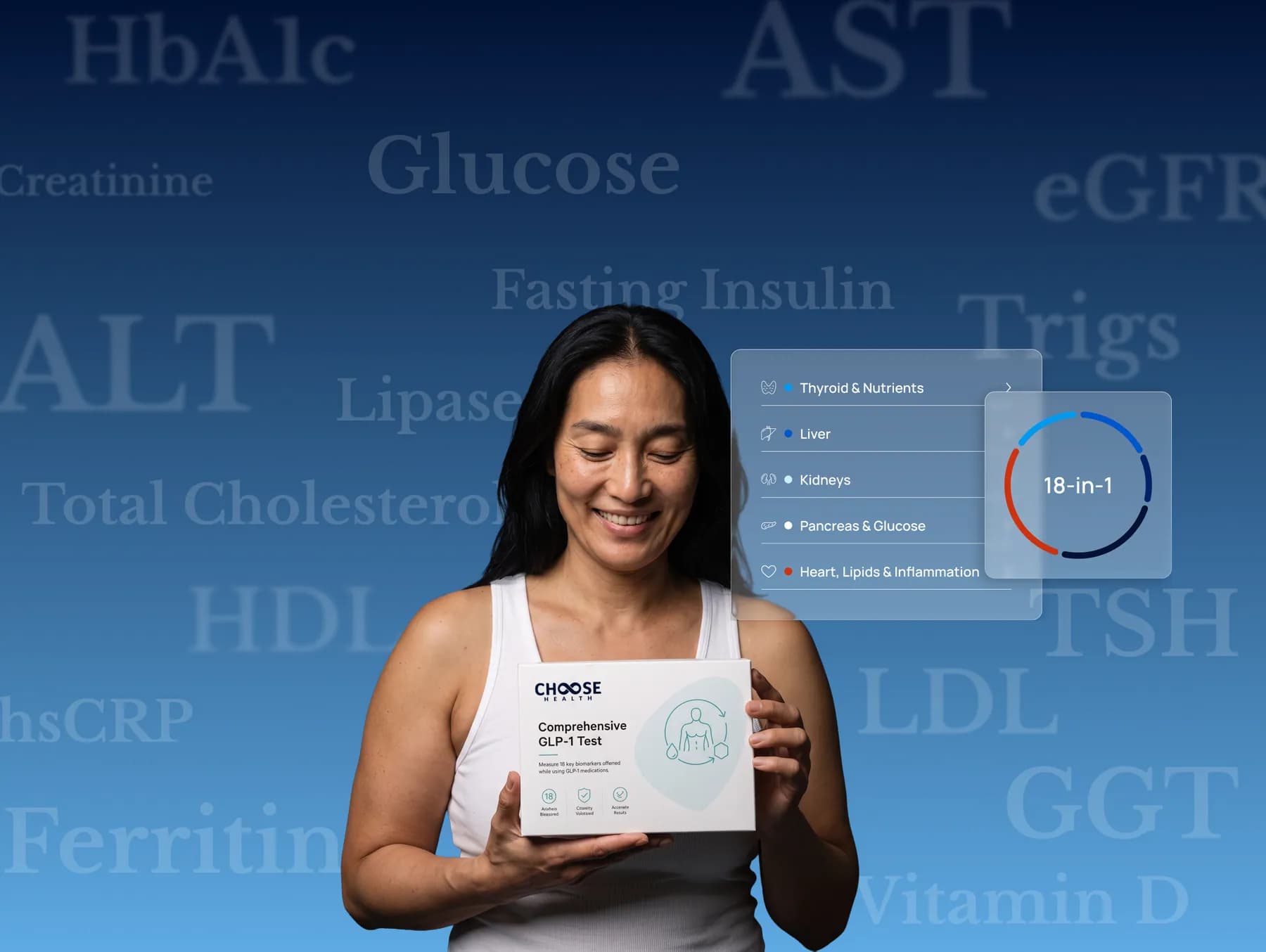
Comprehensive GLP-1 Test - The comprehensive GLP-1 test goes beyond the basic test with a full lipid panel and hsCRP.
Two Liver Function Tests
Basic Liver Function Test - If the primary concern is liver function, the basic liver test is the most economical way to monitor function through 7 essential markers.
Use code LIVER15 for $15 off the basic test.
Comprehensive Liver Function Test - The comprehensive liver test adds another 13 biomarkers, including measurements for metabolic health and a full lipid panel.
Use code LIVER30 for $30 off the Comprehensive test.
At-home liver testing
Choose the level of detail that fits your goals
Start with the Comprehensive Liver Function Test for the broadest view, or choose the streamlined basic panel for essential liver markers.
LIVER30 $30 off Comprehensive LIVER15 $15 off Basic
Kidney Function Test
Kidney Function Test - The kidney function test provides a thorough overview by measuring six key markers connected to kidney health.
Not sure which at-home blood test will be the best tool for monitoring your health while taking peptides? Contact us for personal assistance selecting the right test for your needs.